Persian Carpet Workshops of Qom — A Specialist's Guide

Mirmehdi
Kaffashzadeh
Jamshidi Main Branch
Kashizadeh
Zabihi
Masood
Abbas
Jafar
Meherbaksh
Shobeiri Imani
Bagherzadeh
Sedighian
Jeddi
Eshaghi
Arbalu
Rajabian
Chinese/Indian silk imitation
Unsigned Qom small pieces
Machine-woven carpets

Qom silk workshops selected by the owner

The Persian carpet workshops we carry

With a Persian carpet, who weaves it — and where — determines its value. On this page we first explain what "Qom" and "workshop" actually mean, then introduce, one by one, the workshops whose pieces we bring to Japan.

Understanding the world of Persian carpets

What kind of city is Qom?

Qom became a carpet-weaving city only in the early twentieth century. Compared with ancient centres such as Tabriz or Isfahan, with several hundred years of weaving heritage, Qom is a relatively new production area — just over a hundred years old.

Why is Qom — a latecomer — regarded as the pinnacle?

Because Qom started late, the city was built from the outset around the brand of "the finest silk carpets." Unlike older regions where village and nomadic weaving sit alongside workshop pieces, Qom developed purely as a city-based workshop tradition. Skilled weavers and master craftsmen moved in from nearby Kashan, and from the very beginning the city adopted a small-scale master-atelier model rather than mass production. Today, the great majority of silk carpets woven in Persia originate here.

What does "workshop" (kōbō) actually mean?

The character of a Persian carpet changes significantly depending on where it is woven. Pieces woven by individuals in homes and villages are "unsigned carpets"; pieces woven in city workshops under a master's direction are "signed carpets." It is in the latter world that collector value and recognition as art take shape.

A workshop is a production unit in which a master (in Persian اوستادostad, or master weaver) draws up the cartoon and oversees a team of weavers who complete the work together. Along the edge of the finished carpet, a small cartouche is woven in, naming the master or the workshop in Persian script. This is the "signature" — a guarantee of authorship that carries through any later resale.

How do "workshop pieces" and "unsigned pieces" differ?

Unsigned pieces are woven in homes or small cottage industries and identified only by region. They usually carry no signature, often lack design consistency, and sit at a much lower price point. Workshop pieces, by contrast, are made to a detailed cartoon, with high knot density and consistent quality. Because they are signed, the author and provenance can be traced, and they continue to be recognised by auction houses and specialist dealers decades later. For the same size, prices range from several times to ten times those of unsigned pieces.

How many workshops are there in Qom?

There are workshops of every size, and within the industry a rough hierarchy is shared: "Five Great Masters," "the peak," "upper mid-tier," "mid-tier," and "emerging." The five great master families are Jamshidi, Elami, Kazemi, Mohammadi, and Jeddi. Around them stand Mirmahdi, Nuri, Ranjbar, Salari, and many others. Of these, Golestan delivers to Japan only the workshops with which the owner has built a personal relationship on the ground.

The workshops we work with

Eight workshops chosen by the owner

Mirmahdi Workshop — The Tale of Rostam, the ancient hero (ID7005)

The peak of Qom — a sought-after workshop

Mirmahdi Workshop

Widely regarded as the highest peak in Qom. Say "Mirmahdi" in the Qom market and carpet merchants visibly straighten up. Today's weavers carry on the standing built by Master Mirmahdi, who was still active into the 1980s.

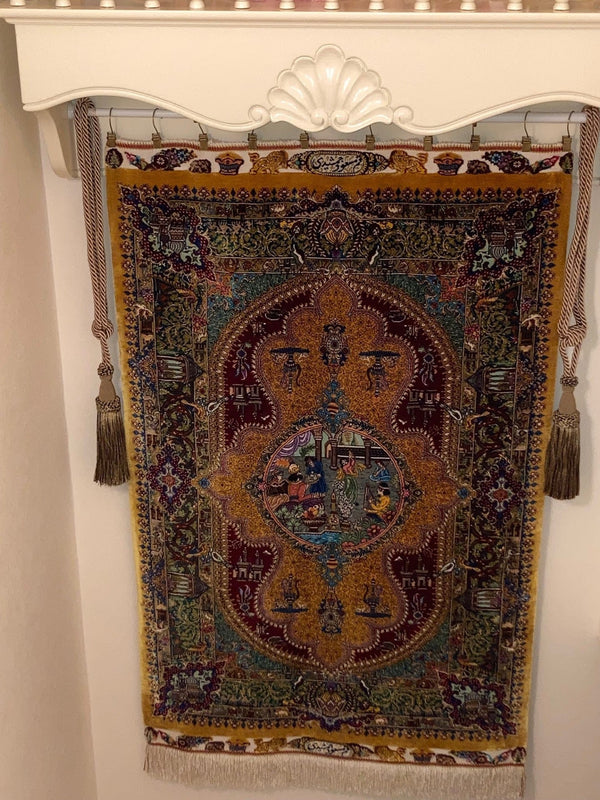
The workshop reproduces Safavid-era (seventeenth-century Persian court) designs in a refined, pale-pastel palette. Signature motifs include the mehrab (a prayer niche drawn from mosque architecture), the goldani (vines and flowers springing from a vase), the Tree of Life, and the Eight Paradises. A single piece takes two weavers between eighteen and twenty-four months. The master's and workshop's names are woven into both ends — a longstanding tradition that makes authorship plain.

"The carpet was far more beautiful in person than in any photograph," is something we hear over and over from Mirmahdi buyers. Golestan is the official agent in Japan, hand-picking every piece.

Mohammad Jamshidi Workshop — Garden of the Night, plant-dyed (ID2300)

Leading family of Qom's Five Great Masters — the plant-dye original

Jamshidi Workshop

The Jamshidi family is at the forefront of Qom's "Five Great Masters." The current main atelier was founded by Mr Mohammad Jamshidi in 1962 and has been carried on across generations. Alongside the main house, the family includes three independent branch ateliers — Masoud, Abbas, and Jafar — each releasing work under its own name.

The defining feature is the plant-dye tradition that only the main (Mohammad) house preserves. Indigo leaves, pomegranate skin, turmeric, madder, and walnut husks are simmered the old way to colour the yarn. The subtle variation between threads creates a depth that chemical dyes cannot match. The three branch ateliers more commonly blend chemical dyes, pursuing their own colour schemes and compositions in compensation.

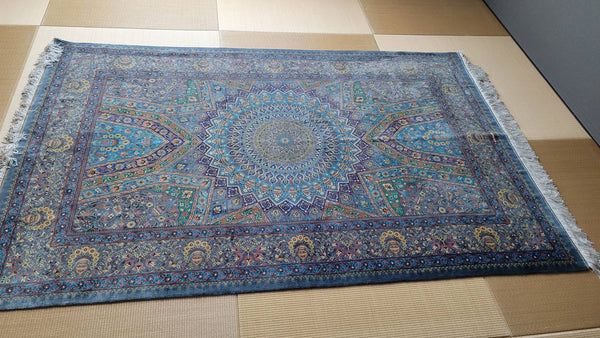
Signature motifs include medallion designs, dome (gonbadi) patterns, and figurative work depicting Persian court culture. The workshop is also known for an unusual technique of "two colours within a single knot."

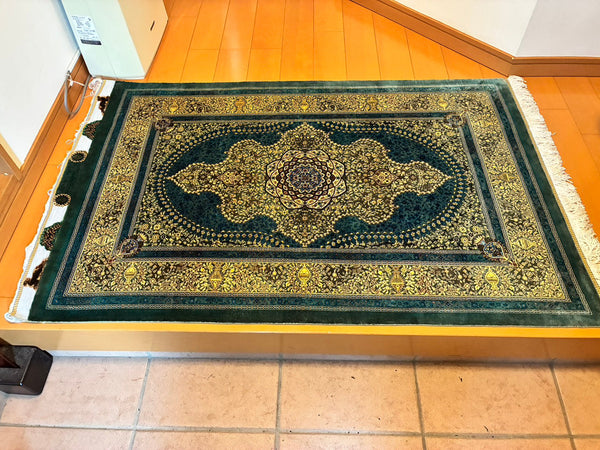
Albalu Workshop — Teal medallion entrance mat (ID8004)

Vivid colour and precision in entrance-mat pieces

Albalu Workshop

Known for vivid colour and precise renderings of the dome (gonbadi) motif drawn from mosque ceilings. Progress is only a few centimetres a month; a single piece takes seventeen to eighteen months, with knot density above 1.1 to 1.2 million per square metre.

The workshop spans entrance-mat sizes through to large living-room pieces, and has a particularly large following of repeat buyers. "Finer and more beautifully finished than what I bought in the local market — at this quality, the price feels more than fair," is something we hear from customers who have purchased on the ground in Iran themselves.

Sedighian Workshop — Living-room medallion of the highest order (ID10001)

Eight-petal medallions and deep grounds — the classical school

Sedighian Workshop

The Sedighian workshop favours eight-petal star medallions set against deep grounds rimmed with gold — a classical school whose dignified work suits formal spaces. Deep greens, deep reds, and indigos sit at the centre of the palette.

An unusually deep green sometimes appears, rare for Qom silk; the owner sets a piece aside on each visit when something exceptional turns up. As one customer wrote, "you can feel the owner's eye and passion in what he brings back."

Abolghassem Jeddi Workshop — Jet-black dome pattern (ID25009)

Generous medallions and entrance mats — a brothers' workshop

Jeddi Workshop

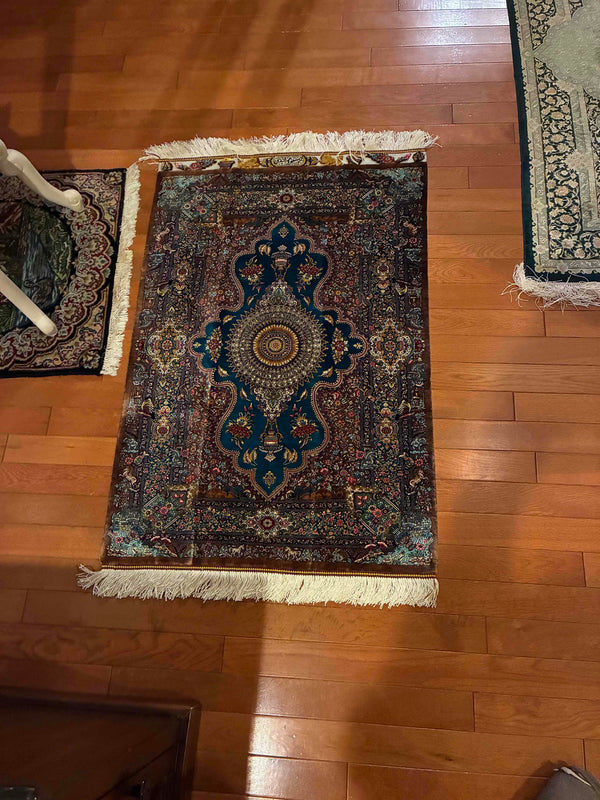
Several weavers from the Jeddi family — Ali Jeddi, Abolghassem Jeddi, and others — work alongside each other. The output centres on entrance-mat sizes with a generous central medallion, and on dome (gonbadi) designs in restrained colours — pieces that take the central role in a hallway or study.

Recent piece names — "Mature Beige," "Quiet Navy" — point to a strength in calm, dignified palettes. Sizes range from roughly 60 × 90 cm entrance mats up to larger pieces.

Eshaghi Workshop — Tree of Life in flourish (ID18013)

Dozens of colours, small florals — a signed master

Eshaghi Workshop

Famous for countless small floral motifs in dozens of colours. From a distance the impression is brightness; up close, the work resolves into an astonishingly fine accumulation of detailed drawing.

"The closer I look, the more I find," is a customer line that captures this workshop well. Long-established European dealers have continued to carry it under the "Signed Eshaghi" banner — placing it firmly in the canon of signed Qom masters.

Rajabian Workshop — Rose Paradise, vivid blue (ID25028)

Rose paradise — bright, decisive colour

Rajabian Workshop

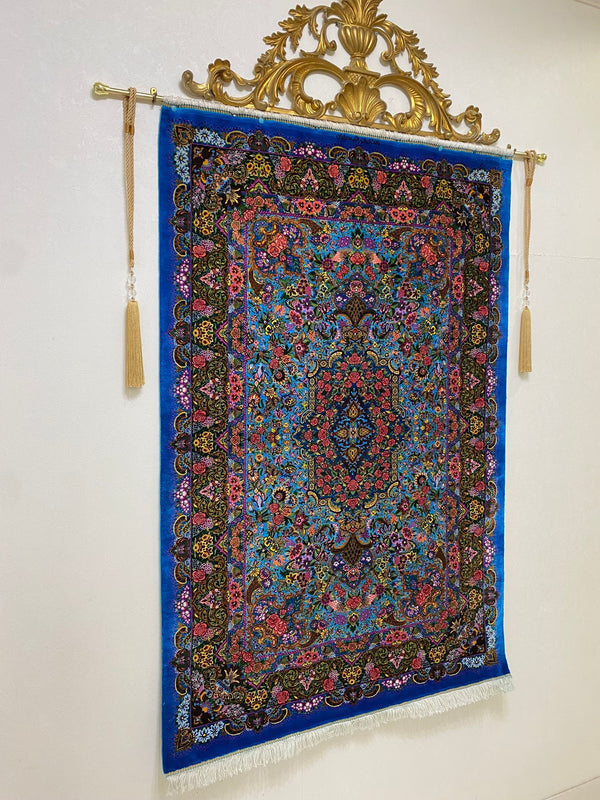
From the Rajabian family, this workshop is at its best in vivid, flower-centred compositions — "Rose Paradise," "Rose Garden," and the like. On grounds of bright blue, deep red, or soft green, the silk's sheen carries the play of light across petal after petal.

Popular in entrance-mat and small wall-display sizes, the work sits naturally inside the contemporary interiors of senior collectors.

Zabihi Workshop — Persepolis pattern in green (ID18028)

Persepolis patterns — historical pictorial school

Zabihi Workshop

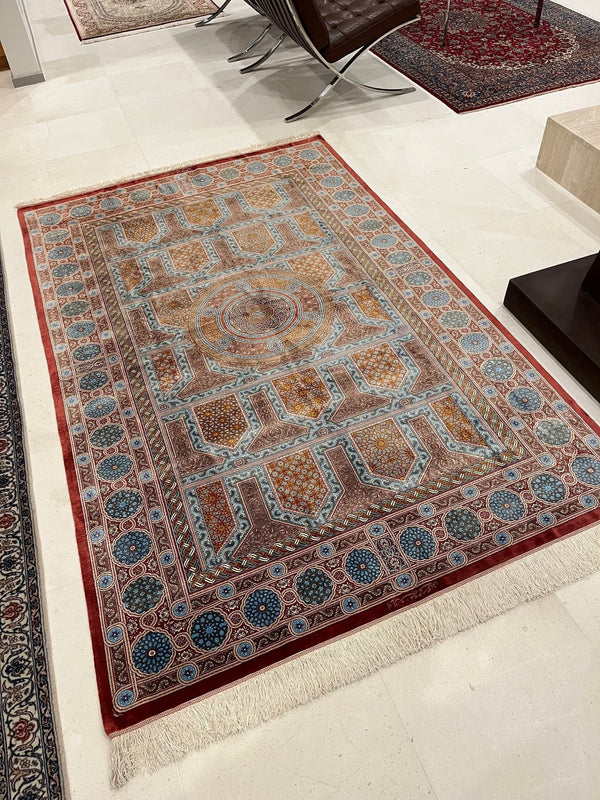
Zabihi specialises in translating the wall-relief carvings of Persepolis — the ancient Persian capital — into silk carpet form. Animals filing along columns, royal figures and other site motifs are brought directly into the composition. It is a rare, technically demanding lineage that also requires deep historical knowledge.

Restrained, deep-green palettes anchor the work, in sizes from entrance mats up to mid-sized pieces. Customers with an interest in history and ancient sites are particularly drawn to it.

For those choosing their first piece

Three guides for choosing:
place, style, and the owner's picks

Each Qom silk workshop has its own character. Take your time, and let us share a few markers from the owner's experience so that you can find a piece that suits your room and your life.

1

Start with place and size

First, decide which room the piece is for. For an entrance hall, about 100 × 150 cm. For the foot of the bed or in front of a living-room sofa, around 140 × 200 cm. As the centrepiece of a formal sitting room, 200 × 300 cm. Once the size is decided, the budget naturally comes into view. If you are unsure, send us a photo of the room — we will reply with suggestions.

2

Find a style you are drawn to

Each workshop has its strengths: medallion designs with a large central emblem, radial dome patterns, the Tree of Life, flower-centred compositions. Choose what feels closest to the furniture in your room and to the colours and patterns you naturally gravitate to. The map above is a guide for sensing quality and price together.

3

Begin with the owner's three recommended workshops

If you are not sure where to start, here are the three workshops the owner can most confidently recommend from years of personal connection.

  • Albalu WorkshopVivid colour work and precision in entrance-mat pieces; a particularly large base of repeat customers.
  • Mirmahdi WorkshopRecognised as the peak in Qom. Golestan is the official agent in Japan.
  • Jamshidi Workshop (main house)The leading family of Qom's Five Great Masters. The depth only the main house's plant dyes can produce — beyond the reach of chemical dyes.

Choosing through conversation usually leads, in the end, to a piece you are happiest with. Please feel free to get in touch with the owner — by email or phone, whichever suits you.

On the workshops bearing the name "Jamshidi"

How to tell the main house from the branches

In Qom, several workshops carry the Jamshidi name. The main house and the branches differ in both dyeing method and style. To save confusion when you are choosing, here is the family laid out.

Jamshidi Workshop (main house)

Leading family of Qom's Five Great Masters

Founded by Mr Mohammad Jamshidi in 1962, the workshop continues to produce work with his eye on every piece.

What the main house preserves is plant dyeing in the old tradition. Indigo leaves, pomegranate skin, turmeric, madder, and walnut husks are simmered to colour the yarn — yielding a depth of colour that chemical dyes cannot reach.

Classical medallion designs, dome patterns, and figurative work depicting Persian court culture sit at the centre of the output, in restrained palettes.

— Other workshops bearing the name Jamshidi —

Masoud Jamshidi Workshop

One of the branch houses. Brings the stories of the ancient Persian court into its compositions; the work is solid and narrative-driven. Dyes are chemical (sometimes alongside natural ones). It operates as an independent workshop, separate from the main house.

Abbas Jamshidi Workshop

Also a branch house. Pursues distinctive compositions and is strong in chemical-dye palettes. The style is plainly different from the main house's.

Jafar Jamshidi Workshop

Likewise an independent branch house. Releases work in its own direction, separate from the main house.

Many workshops share this surname, and from the outside they may seem indistinguishable. We present each as a distinct maker and a distinct workshop. The main house's pieces can be seen in the Jamshidi Workshop collection. If anything is unclear as you choose, please get in touch any time.

Customer voices

Hello 😊 Thank you for your help yesterday. I had a wonderful time seeing and touching so many beautiful rugs. The one I chose a...

The beautiful rug arrived safely, and I'm already enjoying it at home. Thank you very much. As someone who dearly loves Qum rug...

Thank you for your continued support.It arrived safely today, and I've temporarily laid it out in my home.It's such a nice desi...

Today, the item arrived safely. Around the end of last year, I happened to discover Golestan online, and since then, I occasion...

This time, I was able to encounter a truly wonderful and beautiful silk rug. I purchased it online this time, and they kindly a...

Customer Feedback Hello there 😃It's been a while. I hope you're doing well despite the scorching heat every day 🥵. I recently b...

Customer Testimonial I purchased a silk rug from Sedighian Workshop for my entryway. For a while now, I had been searching for...

Customer Feedback Thank you for everything the other day.I was delighted to see various works and to experience the world of Pe...

Customer Reviews I love Persian rugs so much that my family calls me an otaku. I started buying them at department stores and ...

Customer Feedback While researching carpets, I stumbled upon Golestan's carpet store website. I purchased a carpet from them b...

Customer Testimonials The Nahavand carpet has settled in nicely. It was perfect timing and luck; I'm so glad I bought it. I am ...

Customer Review Thank you for letting me visit your showroom and showing me around.  Initially, I intended to lay it in the e...

Enquiries and visits

If you would like to see a piece in person

A workshop you are drawn to, a piece you are looking for, a budget to discuss — please feel free to get in touch about any of it. Customers who would like to see pieces in person are warmly welcomed at our showroom in Fujimi, Saitama. Visits are by appointment.

Contact us